1651
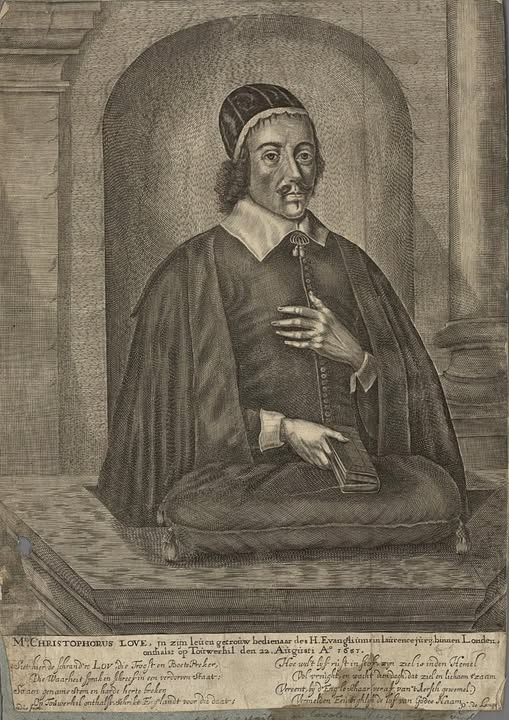
𝐂𝐡𝐫𝐢𝐬𝐭𝐨𝐩𝐡𝐞𝐫 𝐋𝐨𝐯𝐞 died on this day in history, 𝐀𝐮𝐠𝐮𝐬𝐭 𝟐𝟐, 𝟏𝟔𝟓𝟏. He was born in 1618 in Cardiff, Wales. Despite opposition from his father, Love became a dedicated Puritan Christian at the age of 14. He soon matriculated to New Inn Hall, Oxford, and graduated from there with a B.A. in 1639. Continuing his studies in pursuit of an M.A., he was expelled for non-conformity. He was re-admitted, however, and received his M.A. in 1645. He did, however, refuse to subscribe to Archbishop Laud’s new canons of 1640.
While he had been expelled he served as a domestic chaplain to the family of Sheriff Warner in London, where he lived, and where he met his future wife, Mary Stone, the sheriff’s ward. They were married in 1645, and would go on to have six children, one of whom was born after Love died. At one point while Love was serving as a chaplain, William Twisse, the Prolocutor of the Westminster Assembly, came to hear him preach and was so impressed with his preaching that he invited him to come and live with him. However, Twisse died before Love could accept his offer.
Love was later chosen to serve at the Westminster Assembly himself but never approved or added to the roll of official divines. Love had great difficulty getting ordained to the ministry. He was invited to become a lecturer at St. Ann’s, Aldersgate, but the Bishop of London opposed the invitation for three years because Love was not yet ordained. He refused to receive Episcopal ordination, so he eventually traveled to Scotland to seek Presbyterian ordination there, but was not approved because he was unwilling to remain in Scotland and settle there. When the English Civil War began, he served as a lecturer at Tenterden, Kent, and was accused of treason and rebellion (but later acquitted) for maintaining in a sermon the lawfulness of defensive war. He later served as chaplain to Colonel John Venn’s regiment, and later, as preacher to the garrison at Windsor Castle. Even though royalist soldiers did not like his message, he was generally highly esteemed even during this period of his ministry. Finally, with the help of Edmund Calamy, Love was ordained to the ministry on January 23, 1644, at St. Mary Aldermanbury Church. He went to serve as a lecturer at St. Ann’s, Aldersgate for the next three years. From 1650 to 1651, he ministered at St. Lawrence Jewry (about 200 years from St. Ann’s).
During the reign of Oliver Cromwell, Love’s Presbyterian style of preaching became obnoxious to the Independents. Because Charles II had sworn to uphold the Covenants, and Cromwell refused to do so, some English Presbyterians favored the return of the King to the throne. Love and others, including Dr. Roger Drake, William Jenkyn, Arthur Jackson, Ralph Robinson, Thomas Watson, William Blackmore, Matthew Haviland, and Thomas Case, were all arrested and charged with conspiracy to overthrow the government. All were eventually released, however, except for Love, who was condemned to death as an example to the English Presbyterians to prevent further opposition.
He was arrested in May 1651, and his execution was deferred a couple of times, but finally he was put to death at Tower Hill in London on August 23. During his imprisonment, he corresponded with his wife and their letters have gone down in history as one of the most beautiful and touching examples of Christian grace under persecution ever recorded.
In a letter dated July 14, 1651, Mary Love wrote:
“Before I write a word further, I beseech thee think not that it is thy wife but a friend now that writes to thee. I hope thou hast freely given up thy wife and children to God, who hath said in Jeremiah 49:11, ‘Leave thy fatherless children, I will preserve them alive, and let thy widow trust in me.’ Thy Maker will be my husband, and a Father to thy children. O that the Lord would keep thee from having one troubled thought for thy relations. I desire freely to give thee up into thy Father’s hands, and not only look upon it as a crown of glory for thee to die for Christ, but as an honor to me that I should have a husband to leave for Christ.
I dare not speak to thee, nor have a thought within my own heart of my unspeakable loss, but wholly keep my eye fixed upon thy inexpressible and inconceivable gain. Thou leavest but a sinful, mortal wife to be everlastingly married to the Lord of glory. Thou leavest but children, brothers, and sisters to go to the Lord Jesus, thy eldest Brother. Thou leavest friends on earth to go to the enjoyment of saints and angels, and the spirits of just men made perfect in glory. Thou dost but leave earth for heaven and changest a prison for a palace. And if natural affections should begin to arise, I hope that spirit of grace that is within thee will quell them, knowing that all things here below are but dung and dross in comparison of those things that are above. I know thou keepest thine eye fixed on the hope of glory, which makes thy feet trample on the loss of earth.
My dear, I know God hath not only prepared glory for thee, and thee for it, but I am persuaded that He will sweeten the way for thee to come to the enjoyment of it. When thou art putting on thy clothes that morning, O think, “I am now putting on my wedding garments to go to be everlastingly married to my Redeemer.”
When the messenger of death comes to thee, let him not seem dreadful to thee, but look on him as a messenger that brings thee tidings of eternal life. When thou goest up the scaffold, think (as thou saidst to me) that it is but thy fiery chariot to carry thee up to thy Father’s house.
And when thou layest down thy precious head to receive thy Father’s stroke, remember what thou saidst to me: Though thy head was severed from thy body, yet in a moment thy soul should be united to thy Head, the Lord Jesus, in heaven. And though it may seem something bitter, that by the hands of men we are parted a little sooner than otherwise we might have been, yet let us consider that it is the decree and will of our Father, and it will not be long ere we shall enjoy one another in heaven again.
Let us comfort one another with these sayings. Be comforted, my dear heart. It is but a little stroke and thou shalt be there where the weary shall be at rest and where the wicked shall cease from troubling. Remember that thou mayest eat thy dinner with bitter herbs, yet thou shalt have a sweet supper with Christ that night. My dear, by what I write unto thee, I do not hereby undertake to teach thee; for these comforts I have received from the Lord by thee. I will write no more, nor trouble thee any further, but commit thee into the arms of God with whom ere long thee and I shall be.
Farewell, my dear. I shall never see thy face more till we both behold the face of the Lord Jesus at that great day.”
In a letter written on the day of his death, Christopher said:
“My most gracious beloved,
I am now going from a prison to a palace! I have finished my work. I am now to receive my wages. I am going to heaven! Rejoice in my joy. The joy of the Lord is my strength. O, let it be yours also! Dear wife, farewell! I will call you wife no more! I shall see your face no more! Yet I am not much troubled; for now I am going to meet the Bridegroom, the Lord Jesus Christ, to whom I shall be eternally married!
Your dying, yet most affectionate friend until death, Christopher Love,
August 22, 1651, the day of my glorification!”
At his execution, Simeon Ashe and Edmund Calamy stood with him. Roger Wilde was a bystander who later wrote a poem: 𝑇ℎ𝑒 𝑇𝑟𝑎𝑔𝑒𝑑𝑦 𝑜𝑓 𝐶ℎ𝑟𝑖𝑠𝑡𝑜𝑝ℎ𝑒𝑟 𝐿𝑜𝑣𝑒 𝑎𝑡 𝑇𝑜𝑤𝑒𝑟 𝐻𝑖𝑙𝑙, 𝐴𝑢𝑔𝑢𝑠𝑡 22, 1651. Love was buried at St. Lawrence Church, and his funeral sermon was preached by Thomas Manton, although soldiers threatened to shoot him for doing so. Later, many of works were published through the assistance of his friends, including Simeon Ashe, Edmund Calamy and Matthew Poole.
His works include 𝐺𝑟𝑎𝑐𝑒, 𝑡ℎ𝑒 𝑇𝑟𝑢𝑡ℎ 𝑎𝑛𝑑 𝐺𝑟𝑜𝑤𝑡ℎ, 𝑎𝑛𝑑 𝐷𝑖𝑓𝑓𝑒𝑟𝑒𝑛𝑡 𝐷𝑒𝑔𝑟𝑒𝑒𝑠 𝑇ℎ𝑒𝑟𝑒𝑜𝑓 (1652); 𝐻𝑒𝑎𝑣𝑒𝑛’𝑠 𝐺𝑙𝑜𝑟𝑦, 𝐻𝑒𝑙𝑙’𝑠 𝑇𝑒𝑟𝑟𝑜𝑟 (1653); 𝐶𝑜𝑚𝑏𝑎𝑡𝑒 𝐵𝑒𝑡𝑤𝑒𝑒𝑛 𝑡ℎ𝑒 𝐹𝑙𝑒𝑠ℎ 𝑎𝑛𝑑 𝑡ℎ𝑒 𝑆𝑝𝑖𝑟𝑖𝑡 (1654); and 𝑇𝑟𝑒𝑎𝑡𝑖𝑠𝑒 𝑜𝑓 𝐸𝑓𝑓𝑒𝑐𝑡𝑢𝑎𝑙 𝐶𝑎𝑙𝑙𝑖𝑛𝑔 (1658); among others. His wife wrote a lengthy handwritten memoir of her husband which remains in manuscript form at Dr. Williams’ Library and has never been published. His biography was written by Don Kistler: 𝐴 𝑆𝑝𝑒𝑐𝑡𝑎𝑐𝑙𝑒 𝑈𝑛𝑡𝑜 𝐺𝑜𝑑: 𝑇ℎ𝑒 𝐿𝑖𝑓𝑒 𝑎𝑛𝑑 𝐷𝑒𝑎𝑡ℎ 𝑜𝑓 𝐶ℎ𝑟𝑖𝑠𝑡𝑜𝑝ℎ𝑒𝑟 𝐿𝑜𝑣𝑒 (1994).