
Of his latest article about Scottish church history, Paul James-Griffiths of Christian Heritage Edinburgh writes, “This week the article is all about the famous Lewis Revival of 1949-1952. For some reason it has captured the imagination of so many Christians, whilst other revivals have often been forgotten and put into its shadow.”
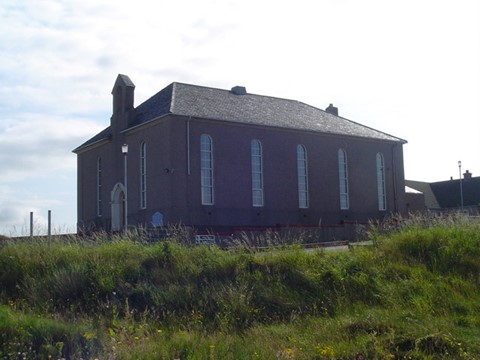
The Church of Scotland at Barvas in Lewis, which was the epicentre of the revival of 1949-1952, photo by Donald Lawson / Barvas Church of Scotland.
One afternoon in our Christian Heritage Centre in Edinburgh, two enthusiastic American Christians greeted me. Within minutes of our conversation, one of them asked, “Have you heard of the Lewis revival?”
“Oh, yes!” I replied, “It’s well known.”
“I love the way that God used two elderly and frail sisters in a poor cottage to usher in the revival through their prayers, when the churches were dead,” one of them stated, matter-of-factly.
“It was awesome how the Holy Spirit fell one night when Duncan Campbell came to preach, with hundreds pouring into the church at Barvas, and hundreds more into the police station to pray,” his friend added.
“My favourite bit was when the Spirit came in power during a dance in the community hall, and about a hundred young people fled and rushed to the church to get saved,” said the first man. “Lights were on in every house as people fell on their faces, convicted of their sin.”
Such “facts” about the Lewis revival have been repeated and grown into legends and myths, spreading worldwide, and yet most of the above points are embellishments, exaggerations, and even falsehoods. Yes, a significant Christian revival did come to Lewis (especially the western side and in parts of Harris) between 1949 and 1952, but the true story, avoiding sensationalism, is much better. The best books for tracing this movement accurately are Sounds of Heaven (2004), by Colin and Mary Peckham, and Island Aflame (2023), by Tom Lennie.
Rather than a revival breaking out because two elderly sisters prayed, the Christians who witnessed the revival tell us that a bigger and deeper revival, seldom known to the general public, had already spread in parts of Lewis between 1934 and 1939, leaving many converted to Christ and transformed. If it had not been for World War II, it would probably have continued. After the war ended in 1945 there was an intense passion for another revival on the island. “The 1949 revival was thus almost a sort-of continuation of a revival which had been interrupted by the sad events in Europe,” relates Mary Peckham, who had been converted there before she was married.
Rev. Murray MacKay was the minister of the Church of Scotland in Barvas, where much of the revival focused during 1949 and 1952, and his understanding, along with Christians all over the island, was that there was a great expectancy and passionate praying for another revival. Rev. Mackay was convinced that they were on the edge of a breakthrough, and repeatedly said, “It only needs a spark!” Yes, the two elderly sisters, Peggy and Christine Smith, did play their small part in prayer, but so did hundreds more like them. “A huge volume of prayer ascended from Christian folk all over the Barvas area for revival,” wrote Mary Peckham. “The place was soaked in prayer.”
Although the locals know nothing about the stories of the dance hall (there was not even a dance hall in Barvas), and the police station being crammed full of praying Christians, or of lights being turned on in every home because people were convicted of sin, they were aware of the presence of God in a very real and tangible way. It seems that Rev. Duncan Campbell, the main evangelist during the revival, was prone to embellish accounts, or get things mixed up, and the exaggerations and misinformation spread from there. However, apart from this he was a godly man whom the Lord used mightily, and he freely admitted, “Revival was already there before I came to Lewis.”
“The awakening broke out in the church in Shader [not in Barvas] on the night of Sunday, 11th December 1949,” said Rev. MacKay, “the awakening spread to Barvas and Borve… You could feel Him in the homes of the people, on the ‘machair’ (common) and on the moor, and even as you walked along the road through the two townships… There are over 100 in this district who have come to saving faith since the beginning of the awakening. God is keeping them all; not one of them has gone back.”
The fruit of the revival was a great love for Christ, holiness, love for the Bible, love for one another and for the lost, and zeal for prayer. Hundreds were converted through this movement, and they often came to Christ in brokenness because of a deep sense of their sin, and found cleansing and new life. Others recount that at the home of Donald and Bella Smith at No.10a in Arnol village, the building shook during a prayer meeting, although no other house anywhere experienced this. One eyewitness I spoke with also recounted a strange heavenly perfume as God descended on weeping sinners who were coming to Christ in Barvas. Without doubt the 1949 revival at Lewis was special, but for some reason the more embellished version has captured the minds of many Christians, whilst its more powerful predecessor between 1934 and 1939 has completely escaped their notice. Moreover, the 1949 Lewis revival never really impacted the mainland, but remained as a localised phenomenon.
“O Lord, revive Your work in the midst of the years!” (Habakkuk 3:2, NKJV).