For the last two years or so I have been completely immersed in reading and studying around the whole subject of church leadership. I have recently taught this course at College and will now post these studies here on a roughly weekly basis.
Having been preaching and teaching for just over fifty years, having pastored three churches, including one which I planted, having had the privilege of preaching in dozens of churches in 20 countries on 3 continents, and having worked with a wide range of church leaders, I have come to the firm conviction that almost every problem in local church life is leadership related. By that I mean that almost all problems arise because of the wrong exercise of leadership, the wrong people in leadership, or the wrong attitude towards leadership by the church members.
But that problem is actually, at least in part, a symptom of a more fundamental one which is the general ignorance, on the part of both church leaders and members as to Scripture’s teaching about leadership roles in the local church.
I have taught through such passages as 1 Timothy 3 in congregations which have had a history of good, solid biblical preaching, only to be met with the comment, “We’ve never heard this before”. I’ve come across men who have spent three or four years at theological seminaries and who have never studied in depth the clear biblical teaching about leadership structures and roles that is found in passages like 1 Timothy 3 and Titus 1. That absence of instruction and preparation is inexcusable.
Even in my own case, despite spending three years at what was at the time one of the very best Bible Colleges in the UK, the Bible Training Institute (BTI) in Glasgow, the attention to this subject was, at best cursory. I still have almost all my lecture notes from those glorious days of teaching and I recently consulted them to see what material I had on church leadership and there is the equivalent of about one side of A4. No wonder our churches are getting leadership wrong.
Some years ago, I remember being struck by something that John Piper wrote. He commented on the fact that he had never led a ‘how to’ seminar on church life because there is so little material in the Scriptures on ‘how to do’ church. And he’s right. But that means we should pay all the more attention to what we are taught in Scripture on the subject. And Scripture is certainly not quiet on how churches should be led. As Alexander Strauch has pointed out, “the New Testament offers more instruction regarding elders than other important church subjects such as the Lord’s Supper, the Lord’s Day, baptism, or spiritual gifts.” 1
Given the straightforwardness and simplicity of the biblical material on this immensely important topic I am amazed and surprised by the variety and complexity of models that have existed throughout the history of the Church and continue to this day, the vast majority of which, in my personal opinion, bear little relation to what we are taught in Scripture.
Part of the problem is that in so many situations, church tradition carries more weight than Scripture. When I taught on this subject in a Baptist church more than twenty years ago, among the responses I got were, and I quote, “We know this is biblical, but we’re Baptists” and “We know this is biblical, but we are Nonconformists”! Denominational Colleges teach their students their position on these important matters without, it would appear, based on the evidence, much recourse to the biblical teaching.
As believers in the reformed tradition, the principle of semper reformanda – always reforming – is needed still, especially perhaps in the area of leading God’s people by the Book. Otto Riecher writes: “The life of the church depends on one thing: her return to biblical principles.” And that’s what we are involved with right now – a return to Scripture.” 2
Before we look at the biblical teaching on this all-important subject, let’s take a look at the forms of church governance and leadership structure that commonly exist today. Historically, four main forms of church government are observable, of which there are numerous variations.
Presbyterianism
(my graphics here are from Grudem’s Systematic Theology)
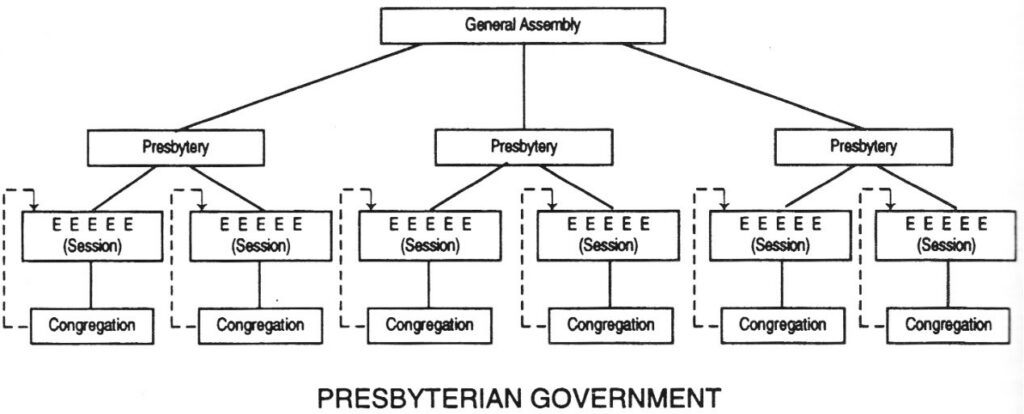
This form of church government is what might be called hierarchical-representative, and the term comes from the Greek word presbuteros (πρεσβύτερος) meaning elder. In the plural, presbuterion is a Council of Elders as in Luke 22:66; Acts 22:5 (both secular contexts) and 1 Timothy 4:14.
This structure is hierarchical, in that it has various levels of authority above the local church, variously termed presbytery, consistory, synod or General Assembly, though the local congregation, under the leadership of the elders, chooses those who will lead them.
At the local congregational level, there are usually two groups of leaders – elders and deacons.
The eldership is a plurality, usually known as the session or consistory, and being elected or appointed, they have authority in the church as representatives of the congregation. The Minister of the church will be one of the Elders, the Teaching Elder, and serves as Moderator of the Session.
According to Presbyterianism, there are two types or kinds of elders – teaching elders and ruling elders.
The teaching elder is usually the paid minister who is appropriately trained, ordained, and has been thoroughly examined by the presbytery, which is made up of the members of sessions from several local churches.
Usually, this teaching elder does most, if not all, of the preaching and teaching.
He is also in charge of officiating at other duties, such as the sacraments of baptism and communion.
The ruling elders are essentially lay, or bi-vocational, elders, who have not necessarily been ordained or trained.
This twofold distinction is based on their understanding of 1 Timothy 5:17: “Let the elders who rule well be considered worthy of double honour, especially those who labour in preaching and teaching.”
The elders of the local church are also members of a Presbytery, which consists of some or all of the elders from a group of local churches, and which has authority over several churches in that area.
Some of the members of the Presbytery are elected as members of the General Assembly which has authority over all the Presbyterian churches in a nation or national region.
Episcopalianism
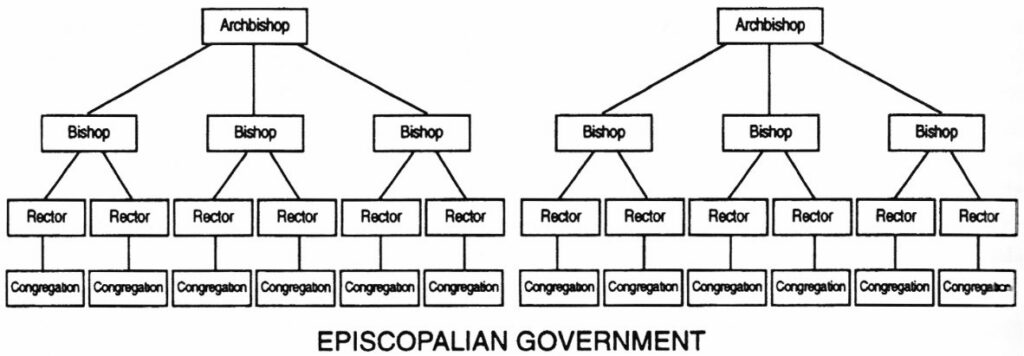
This form of church government is hierarchical-monocratic and is the structure practiced by Episcopalians, Anglicans, Methodists, Eastern Orthodox churches, Roman Catholics, and some Lutherans. The term episcopal comes from the Greek word episkopos (ἐπίσκοπος), which means bishop or overseer. Although there is some disagreement between the different episcopalian denominations, they all share the central concept that authority resides in the office of the bishop.
The bishop is distinct from, and superior to, the leaders at the local church.
In practice, this means that the bishop is responsible for ordaining and appointing leaders, variously known as priests or rectors, to local congregations and is usually responsible for several local churches, known as a diocese, rather than merely one local congregation.
Episcopal government is based on the belief that Christ, as the head of the church, has entrusted the leadership of the church to the bishops, who are the successors of the apostles.
Episcopal authority is based on apostolic succession, and the function of the apostles is passed on to the bishops they ordained by the laying on of hands.
Methodism has the simplest form of episcopacy, having only one level of bishops.
Other denominations, for example the Anglican and Episcopal churches, also have archbishops who have authority over many, or sometimes all, of the bishops.
Roman Catholicism has the most developed episcopal system, having not only archbishops but also a pope, who is the bishop of Rome and is above all the archbishops and has absolute and ultimate authority over the church.
This structure of church governance is hierarchical in that it has various levels of authority, and the various tiers of leadership are chosen from above and not from below.
It is monocratic, in that the congregation does not vote on or choose its leader, but someone in a higher position, ie the bishop, – appoints the leader for the congregation.
So, authority rests neither in the congregation, nor even in the congregational leadership, but with the bishops.
Congregational
Most congregational churches do not have a denominational hierarchy but are autonomous, self-governing bodies, with each local congregation, under the authority of Christ and his Word, governing itself, independently of other congregations. The authority rests with the local congregation which decides important matters without being subject to external bodies or officials.
In practice, in many cases, the local church may be subject, to a greater or lesser degree, to the authority of a denominational or other structure. Many congregationally governed churches are members of denominational groupings which have varying powers of authority over them. In other cases, many are affiliated to fellowships of like-minded congregations, while many are not connected in any meaningful way with other churches.
There are differing forms of congregational church government:
Non-Governmental
This form of church government is held by some Brethren and other independent congregations. The need for a formal church structure is minimized, and stress is placed on the leading of the Holy Spirit who influences and guides believers in a direct manner, rather than through an organization. While great emphasis is placed upon the priesthood of all believers, there are often elders who help lead the congregation. However, preaching and teaching are not limited to the elders, but freedom is given to allow the Holy Spirit to prompt others to share God’s Word.
Authority and decision making is usually exercised in the form of the majority vote of the congregation and the claimed biblical basis for this style of governance is the doctrine of the priesthood of all believers.
Single Elder / Pastor
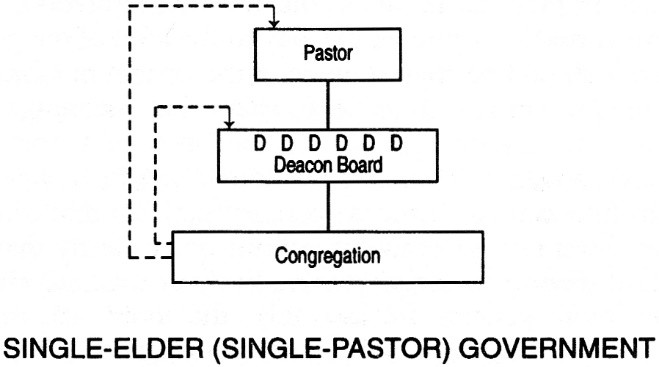
The single Elder is the Minister or Pastor who is appointed by the local congregation.
The local congregation elects some of its members to serve as Deacons and they provide support for the Pastor.
In practice, most commonly the Pastor and Deacons govern together, functioning like a plurality of Elders.
Even though usually led by a Pastor, with Deacons in a supporting role, ultimate authority lies with the meetings of the members of the church.
Plurality of Elders / Pastors
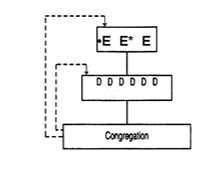
The local church recognises several leaders who serve as Elders.
The Pastor or Minister is one of the Elders and will normally function as a ‘first among equals’ by dint of his particular calling and training and, often, full-time role.
The local church may also elect Deacons who look after the practical and organisational affairs of the congregation.
Most decisions affecting the congregation are decided by a meeting of the members of the church.
Elder Led
The local church recognises several leaders who serve as Elders.
The Pastor or Minister is one of the Elders and normally will function as a ‘first among equals’ by dint of his particular calling and training and, often, full-time role.
However, no one person is singled out as the pastor, or senior pastor, but each of the elders is given equal authority.
Unlike in Presbyterianism, these elders do not have any authority outside their local church, and no distinction is made between teaching and ruling elders.
The local church may also elect Deacons who look after the practical and organisational affairs of the congregation.
All but exceptional decisions are made by the Elders who, when serving well, have the trust and confidence of the church members.
Let me ‘set my stall out’ right from the start. Having spent much time studying this whole area in considerable detail I am totally persuaded that the biblical pattern for the local church is that it should be independent and led by male elders who are plural, equal and local.
“It is your duty to search and study the Scriptures and bring all things to the Law and to the Testimony … When either doctrine or worship is corrupted in a church, the way to reform both is not to fly to human authority or antiquity, but to the golden rule of the Word.”3
I am not saying that other structures and systems are necessarily wrong, simply that you cannot argue from Scripture that they are based on biblical teaching, and in coming studies we’ll examine the claims made by those who defend their position from Scripture. However, there is one model that I do think is entirely wrong, although very common and popular – non-governmental; or as I recently heard it described – member led. That is without doubt the worst of all worlds!
Conclusion
We need to remember that, while not an unimportant matter, church government is a secondary rather than a primary issue. Historically, as with other matters of doctrine, genuine believers have differed in their views on this issue and God has been pleased to bless churches of all forms of government.
However, there are biblical principles and patterns that need to be recognised and this is not an area of Christian practice where we are simply at liberty to do whatever we feel works best or suits our personal or collective preferences.