
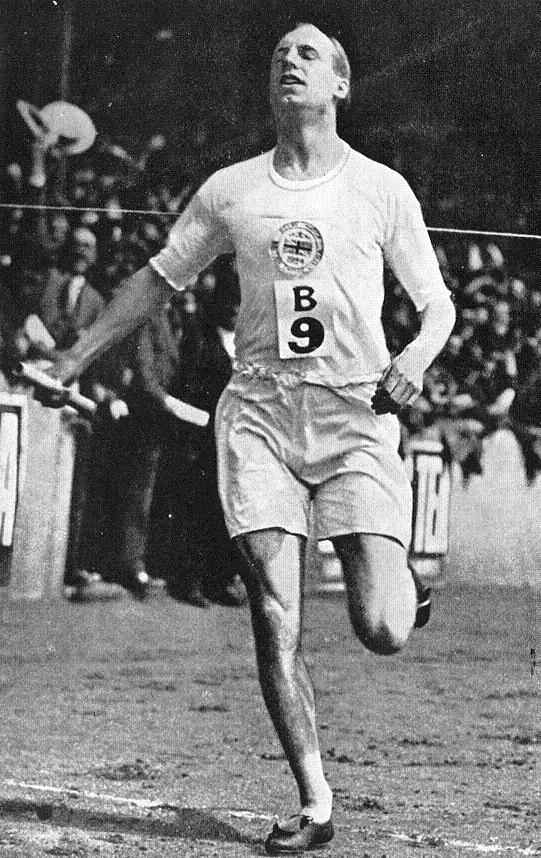
Of his latest article about Scottish church history, Paul James-Griffiths of Christian Heritage Edinburgh writes, “This week’s article is all about Eric Liddell, one of Scotland’s best-known Christians. He combined Olympic professionalism with a vibrant faith and spent many years as a missionary in China.”
Whenever I take groups to St Andrews for a Christian Heritage Tour, inevitably there are two other things my guests would like to see: the old Swilcan Bridge, a small structure made famous by champion golfers, and the West Sands, now remembered as an iconic scene for the film, Chariots of Fire. This classic film centres around the lives of three Olympic sprinters: Harold Abrahams, Lord Andrew Lindsay, and Eric Liddell. It is the Scotsman, Eric Liddell, however, who steals the show.
Eric Liddell was a rugby player for Scotland and the famous sprinter who won the Olympic gold medal for the 400-metre race in Paris, in 1924. He had turned down his favourite race, the 100-metre sprint, because of his Christian conviction of not wanting to run on Sunday. “No athlete,” wrote Dr Neil Campbell in The Story of Edinburgh University Athletic Club, “has ever made a bigger impact on people all over the world, and the description of him ‘as the most famous, the most popular, and the best-loved athlete Scotland has ever produced’ is no exaggeration.”
On one of our tours in Edinburgh I met a retired church minister who told me that a former member of his congregation in America, had been the young woman who had nursed this Christ-like man in the Weihsien Japanese concentration camp during World War II. In the film Chariots of Fire Eric Liddell’s faith shone, for when he ran, he felt God’s pleasure, but far away from the applause and accolades of a worldly race, he lay dying from a brain tumour as a missionary in China. Scotland went into mourning for the death of its favourite son, but we forget that his best race was in China as he lived and died for the Chinese, that they might hear the gospel.
In 2015 a statue in honour of this man was put up in the city of Weifang, in East China’s Shandong province, out of respect for a national hero. His daughter Patricia unveiled the statue before Chinese officials, and told the Times of London that she found it “extraordinary that a statue has been raised – the Chinese don’t really raise statues,” she said, “maybe just for Mao Zedong.” Liddell had been born in China, grew up there, and returned to bring Jesus to his people in a selfless way. When the Japanese had overrun China in the war, his wife and daughters fled to safety, but Liddell remained to care for the needy. It was revealed in 2008 that Winston Churchill had brokered a deal with the Japanese to free him, but he chose to give up his place to a pregnant woman instead.
When Eric Liddell studied science at the University of Edinburgh, he would have been familiar with the Christian heritage of this city, with its Reformers and Covenanters, but he would have also been very aware of Scotland’s rich missionary history. He had been born in Tianjin of missionary parents, and they had trodden on the path of many Scots who had gone before them in this vast country of China. In this article I will leave you with some quotations from Eric Liddell.
“I believe God made me for a purpose, but he also made me fast! And when I run, I feel his pleasure.”
“It has been a wonderful experience to compete in the Olympic Games and to bring home a gold medal. But since I have been a young lad, I have had my eyes on a different prize. You see, each one of us is in a greater race than any I have run in Paris, and this race ends when God gives out the medals.”
“God uses the law [the Ten Commandments], like a skilful physician, to bring my sore to a head in order that he might heal. The law was not a means of salvation, but only a means to show the need for salvation.”
“Every Christian should live a God-guided life. If you are not guided by God, you will be guided by someone or something else.”
“Therefore we also, since we are surrounded by so great a cloud of witnesses, let us lay aside every weight, and the sin which so easily ensnares us, and let us run with endurance the race that is set before us, looking unto Jesus, the author and finisher of our faith, who for the joy that was set before Him endured the cross, despising the shame, and has sat down at the right hand of the throne of God” (Hebrews 12:1-12, NKJV).