1663
The Mather family played a pivotal role in shaping the history of New England, with Richard Mather bringing seeds to America and his son Increase serving as president of Harvard. Cotton Mather, the third generation of Mathers, was a complex figure whose works on witchcraft and theology are still studied today, despite being tainted by his involvement in the Salem witch trials.
Richard Mather brought the family seeds to America. A well-educated minister in the Church of England, he had been suspended from his pulpit for refusing to conform to the mandatory practices of the established church. He migrated to Boston in August 1635 where he became a Puritan pastor, exerting his influence not only from the pulpit but through production of the Bay Psalm Book. His son, Increase Mather, was likewise a pastor and author, whose life is closely intertwined with the history of Massachusetts. Perhaps his greatest service was to act as an agent of the colony in resisting Charles II’s revocation of its charter. He also served as president of Harvard and earned America’s first Doctor of Divinity degree.
The third person of this Mather trilogy was perhaps the most notable of all. Cotton was born on this date, February 12, 1663. Like his famous father and grandfather he entered the ministry. Acutely aware of sin in himself, from a young age he subjected his body to fasts and vigils and his mind to periodic self-examination. Six times a day he broke off business to pray and meditate. As a man he was unusually introspective. One wonders if he placed trust in works or in Christ. Sometimes he claimed direct illumination from God and at other times groaned or swooned. Often he felt plagued by demons.
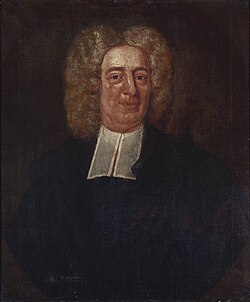
Convinced from his own experience of the real power of Satan, he supported witch hunting. At the urging of the Salem court, he wrote Wonders of the Invisible World which described the Salem witch trials. It is unfortunate that he did not pay more heed to his father’s opposite views. Cotton’s name is forever blemished by the Salem witch trials, which show how badly superstition can warp an otherwise intelligent man.
For he was an intelligent man. 444 of his works were printed in his day, including a fascinating and valuable history of God’s workings in New England. The Royal Society of London elected him a member and read his scientific papers. The Christian Philosopher was his foray into apologetics. “The works of the Glorious GOD in the Creation of the World are what I now propose to exhibit; in brief Essays to enumerate some of them, that He may be glorified in them…” He quoted often from his large and valuable personal library.
Cotton was not merely a scholar. His pastoral care and rapport with troubled teens won admiration. He actively participated in the hour’s political roly poly, for example, justifying the seizure and imprisonment of the colonial governor Edmund Andros.
He died February 13, 1728. With him the Mathers fade from New England’s center stage. However, the first three were so great that their name remains inseparable from the history of the region.
1915
On this date, 12 February 1915, Fanny Crosby died at the age of ninety-five. Blind from an early age, she left behind thousands of hymns, many of which remain favorites of the church.

Frances Jane Crosby was born in New York on 24 March 1820. As a baby, she contracted an eye infection. A quack doctor treated her by placing hot poultices on her inflamed eyelids, resulting in scarring that left her blind.
Fortunately for her, a godly neighbor, Mrs. Hawley, taught her large portions of scripture. Her grandmother also encouraged her to appreciate the physical world around her through her senses of touch, hearing and smell. She could identify birds by their songs and trees by their leaves. Crosby’s grandmother explained the Bible to her and emphasized the importance of prayer. When Crosby became depressed because she could not learn as other children did, her grandmother taught her to pray to God for knowledge.
Crosby had a gift for rhyme. When only eight she wrote this verse:
Oh, what a happy child I am,
Although I cannot see!
I am resolved that in this world
Contented I will be!
How many blessings I enjoy
That other people don’t!
So weep or sigh because I’m blind,
I cannot—nor I won’t.
Through her Christian upbringing, she learned that she could be useful in spite of her sightlessness. However, she did not truly yield her heart to Christ until she attended a camp meeting when she was thirty.
Afterward she said the Lord assured her he had a work for her, and that work was hymn writing. She soon met William Bradbury, a leading composer of Christian hymn tunes, and began writing furiously. The results of her labor were vast: Crosby wrote the equivalent of about fifteen hymnals. Among her most famous hymns are “Blessed Assurance,” “All the Way My Savior Leads Me,” “To God be the Glory,” “Pass Me Not, O Gentle Savior,” “Rescue the Perishing,” “Jesus Keep Me Near the Cross,” “I am Thine, O Lord,” “A Wonderful Savior is Jesus my Lord,” “Praise Him! Praise Him! Jesus our Blessed Redeemer,” and many more.
When Crosby died on this day she did so in the expectation of seeing face to face the Savior who had brought light to her many years of earthly darkness.